Best Small Office Chair for Tight Rooms and Narrow Desks
A compact office chair should fit under the desk without making you give up basic back support. These two picks suit different workdays.
By Alex Turner
Homeofficebasics is reader-supported. As an Amazon Associate we earn from qualifying purchases. Learn more.
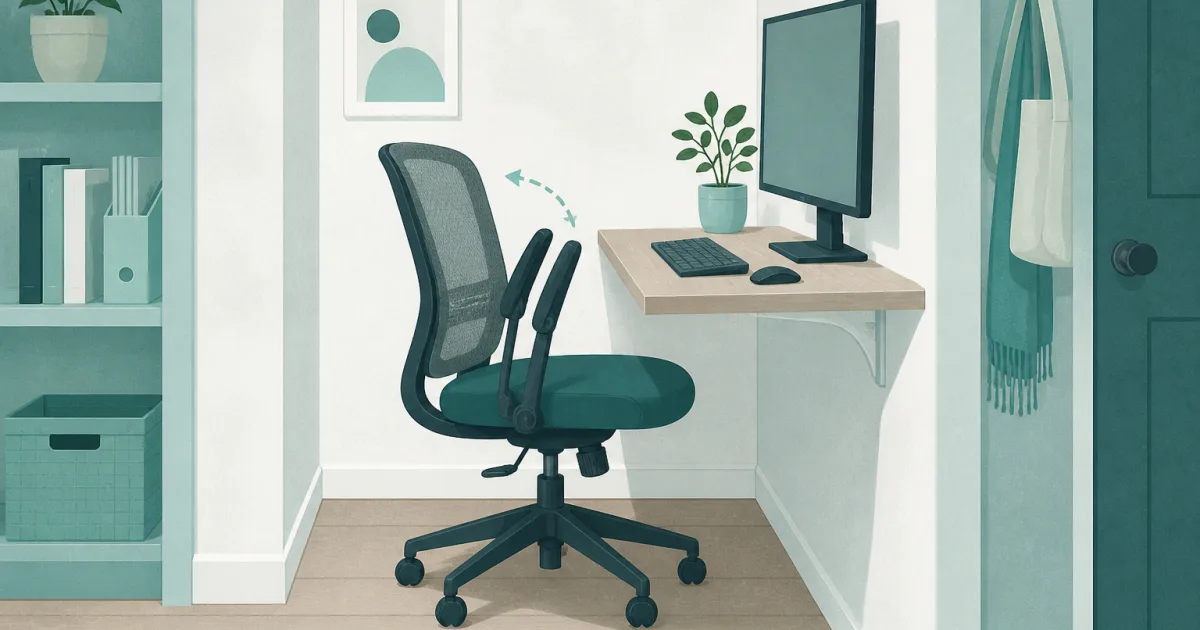
The short answer: The Furmax Office Desk Chair with Flip-Up Arms (paid link) is the best small office chair when you work at the desk most days. Its arms lift so the chair can tuck close to the desktop, while the mesh mid-back gives you more support than a tiny armless seat. Choose the Amazon Basics Low-Back Mesh Office Chair (paid link) for the tightest corner, closet office, or occasional workspace.
Our picks
A chair can look compact online and still block the only walkway in your room. The base may be wider than the seat. Fixed arms can hit a drawer. A deep backrest can leave the chair sticking out even after you finish work.
The Furmax and Amazon Basics models solve the space problem differently, so the right pick depends on how long you sit and where the chair needs to go after work.
Our two compact office-chair picks
The Furmax is the better desk chair for most small spaces because it keeps useful arms during work and moves them out of the way afterward. The Amazon Basics chair is the honest minimum-footprint option. It is easier to fit, but it asks you to accept fewer adjustments.
Best overall: Furmax Office Desk Chair with Flip-Up Arms
The Furmax Office Desk Chair with Flip-Up Arms (paid link) is a mid-back mesh chair built around a simple space-saving idea. Use the padded arms while typing, then rotate them upright before pushing the chair under the desk. That makes it more practical than a chair with fixed arms in a bedroom office or narrow work nook.
The chair has a padded mesh seat, a breathable mesh back, pneumatic height adjustment, tilt tension, and a 260-pound listed capacity. Its back gives more contact than a low-back task chair without adding a headrest that makes the chair visually and physically larger.
Useful notes from owners describe straightforward assembly, a supportive mesh back, and the convenience of the folding arms. Recurring complaints mention a firm seat, limited adjustment, and gas-lift wear over time. Those are fair warnings for a budget chair.
The flip-up arms save room only if the chair and desk fit at your typing height. Check the arm pivot, seat width, and wheelbase against the opening under your desktop. A shallow drawer can still stop the backrest before the chair is fully tucked away.
Check it: Furmax Office Desk Chair with Flip-Up Arms on Amazon (paid link)
Best for the tightest space: Amazon Basics Low-Back Mesh Office Chair
The Amazon Basics Low-Back Mesh Office Chair (paid link) strips the design back to the essentials. There are no arms, headrest, or bulky upper-back frame. Amazon lists it at 22.5 inches wide, so it can work beside a narrow desk, at a sewing table, or in a closet office where a full ergonomic chair simply will not fit.
You still get a padded seat, breathable low back, height adjustment, swivel, casters, and a 275-pound listed capacity. The lack of arms gives you freedom to turn sideways and move close to the desk. It also means the desk surface may need to support your forearms during longer typing sessions.
Owners commonly like the value and small footprint. The clearest limitation is equally consistent: this is a basic task chair with no recline and little adjustment beyond height. Some people replace wheels over time. That is normal for a compact budget chair.
Choose it for short work blocks, a secondary desk, or a room where every inch matters. Skip it for full-day sitting if you already know that you need adjustable arms, stronger lumbar contact, or several recline positions.
Check it: Amazon Basics Low-Back Mesh Office Chair on Amazon (paid link)
Measure the room before the chair
Start with the real path the chair must travel, not the product's seat width.
- Desk opening: Measure the clear width between drawers, legs, and cabinets.
- Under-desk height: Measure from the floor to the lowest drawer or support rail.
- Wall clearance: Measure from the desk edge to the nearest wall, bed, or closed door.
- Base width: Check the full caster base, which is often wider than the seat.
- Turning room: Make sure you can swivel and stand without trapping your knees.
- Storage position: Decide where the chair sits when the workday is over.
Measure with the desk set to your actual typing height. Lowering a chair to make its arms fit under a desk is not useful if that position leaves your shoulders raised all day.
If the desk is also part of the problem, our small standing desk guide covers compact work surfaces. The home office desk setup guide can help you place the screen, keyboard, and chair before buying more furniture.
Flip-up arms or no arms?
Flip-up arms make sense when you want forearm support during work but need the chair to disappear under the desk afterward. The Furmax follows this approach. The arms are not deeply adjustable, but moving them out of the way solves a common fit problem.
An armless chair saves the most width and reduces collisions with drawers. It also lets you approach the desk from an angle in a tight room. The Amazon Basics chair is better when the workspace is used for shorter sessions and the desk edge can support your forearms.
Do not assume armless means ergonomic. If you float your arms above the keyboard for hours, your shoulders may creep upward. Keep the keyboard close, lower the work surface if needed, and use the chair for the amount of time its simple support can reasonably handle.
Compact does not mean one-size-fits-all
A small chair can be too shallow for one person and too deep for another. Seat depth matters because your back should reach the backrest while a little space remains behind your knees. Seat height matters because your feet should rest flat without forcing the desktop too high.
The Amazon Basics chair has a low back and narrow overall form, but that does not guarantee a good fit for every shorter user. The Furmax has more back support, yet its fixed seat depth may still be wrong for your legs. Use the return period as a fit test and keep the packaging until you have completed several normal work sessions.
For a broader fit checklist, read our best office chair guide. If price is the main constraint rather than room size, the best budget office chair guide compares models with a wider range of adjustments.
Floor, casters, and the space around the chair
Casters make a compact chair easier to move, but the floor changes how much room you need. Thick carpet can make a small wheelbase feel stuck. Hard casters can slide too quickly or mark a wood floor.
Check the caster type and consider the floor before measuring your final movement area. A mat may add a lip or require more width than the chair itself. If your office has carpet, see our chair mat for carpet guide for surface-specific sizing.
Avoid squeezing a rolling chair into a passage where one caster can catch a rug edge or door threshold. The smallest chair is not a good fit if you cannot sit down and stand up safely.
Which compact office chair should you buy?
Buy the Furmax if you work at home regularly, want mesh airflow, and have enough room for a mid-back chair once its arms are raised. It gives up advanced adjustments, but its basic support makes more sense for longer work blocks than an ultra-small task chair.
Buy the Amazon Basics Low-Back Mesh if the room is genuinely tight, you work there for shorter periods, or the chair must slide beneath a small table with no room for arms. Its simple design is the benefit and the limitation.
Skip both if you need a headrest, adjustable seat depth, highly adjustable arms, or a broad seat. A larger chair that fits your body is better than a compact one that creates a daily strain. In that case, reorganize the desk area before forcing the wrong chair into it.
Bottom line: The Furmax Office Desk Chair with Flip-Up Arms (paid link) offers the best balance of everyday support and compact storage. The Amazon Basics Low-Back Mesh Office Chair (paid link) is the better choice when minimum width and an armless design matter most. Measure the desk opening, wheelbase, and wall clearance before ordering either chair.
Frequently Asked Questions
What is the best small office chair for a tight room?
The Furmax Office Desk Chair with Flip-Up Arms is the better all-around small office chair for regular home-office work. Raise the arms to slide it closer to the desk. Choose the Amazon Basics Low-Back Mesh chair when the smallest possible footprint matters more than arm support.
What is the best office chair for a small space?
Same shortlist. Start with Furmax if you sit most workdays. Use Amazon Basics when the chair must disappear under a narrow desk or into a closet office.
Should a small office chair have arms?
Arms can support your forearms, but fixed arms often stop a chair from sliding under a narrow desk. Flip-up arms are a useful compromise. An armless chair saves more room but may be tiring if the desktop does not support your forearms.
How much room do I need behind a desk chair?
Measure from the desk edge to the nearest wall, door, or bed. Leave enough room for the chair base, your knees, and a safe path to stand. A compact chair still needs space to roll back without hitting furniture.
Is a low-back chair good for working all day?
A low-back chair can work for short sessions, but it offers fewer ways to change posture. For full workdays, a supportive mid-back chair with usable arm support is usually a better starting point if the room allows it.
How do I know whether a chair will fit under my desk?
Compare the desk clearance with the chair's arm height and seat width at the exact height you use for typing. Include any drawer or support rail under the desktop. Product photos rarely show these clearances accurately.
Can a small office chair work in a bedroom?
Yes, if you measure the path between the bed, desk, and door. Flip-up arms help the chair tuck away after work so the room can go back to being a bedroom.